I’ve been fascinated by Uluru ever since I first heard about it years ago, back when I worked at a travel arm of a bank. There was something about that great red rock in the middle of Australia — older than mountains, older than memory — that stayed with me.
More than 550 million years old, Uluru was already there when dinosaurs roamed the earth.! Imagine that ! It rises 348 metres above the desert floor, but what you see is only part of the story. Much of it extends several kilometres underground. Bigger in landmass than Monaco, it’s not just a rock; it’s a monument carved by wind, rain, and reverence.
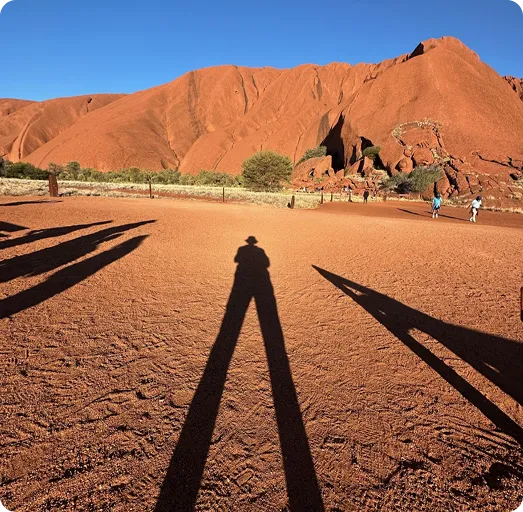
Uluru looms immediately when you get out of the airport. In fact even on the plane, if you are the left window seat,Uluru is visible from the air.
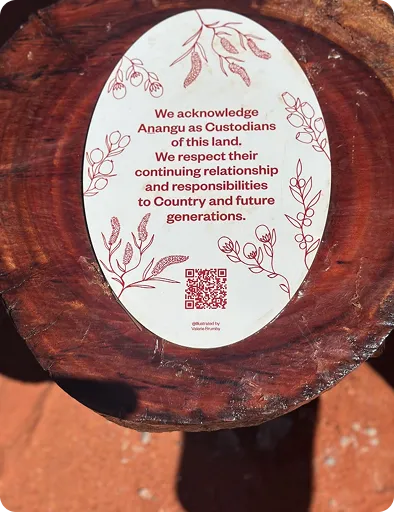
I was so excited to see right in front of me after leaving the airport. We seem to be getting closer and closer to it . Uluru is one of the most sacred sites in Australia for the Anangu people, the traditional custodians. It is deeply tied to their Tjukurpa (often translated as “Dreamtime”), which tells of creation stories and ancestral beings.
I settled into my room at The Outback Hotel.
I was so glad that I chose this hotel over the fancier Sails in the Desert . My room opened up to rows of gum trees with perfect white barks – possibly smoother than mine . It was the perfect backdrop for the evening as I got ready for a view of Uluru at dusk . I have a vision of imagined the big red rock changing colours in the golden hours .
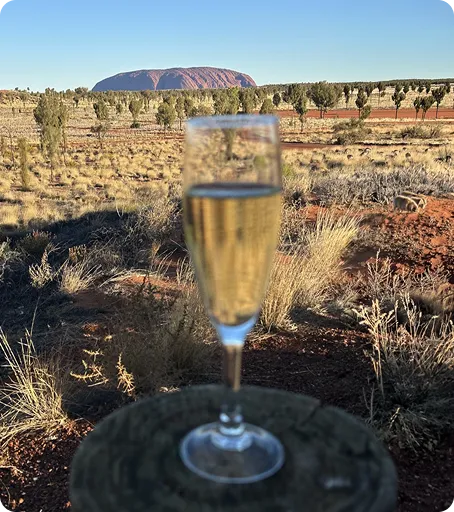
And I was not wrong. It was pretty magical to have the Uluru in your direct line of vision as its red colour flashed and ebbed with the setting sun. Plus a glass of sparkling wine to celebrate the moment . I felt a surge of joy . My heart sang. It felt sacred and special.
Uluru was first sighted by Europeans in 1873, when explorer William Gosse became the first non-Aboriginal person to reach it. He named it after Sir Henry Ayers, then Chief Secretary of South Australia. But for the Anangu people, the original inhabitants of the land, the rock was never something to “discover.” It had always been alive — a sacred presence woven into Dreamtime stories that explain the origins of the world. Today , there are just 350 of them in Uluru , descendants of a culture that has lived here for more than 22,000 years.
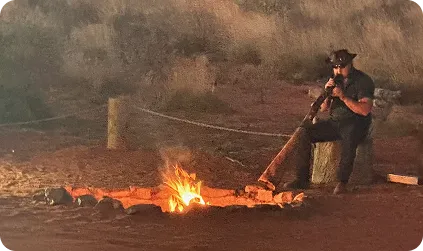
That evening, after the sun slipped below the horizon, the air turned cool and still. The sound of the didgeridoo filled the night – deep, earthy, and strangely calming. Above us, the stars the stars slowly emerged. Soon, it felt like a full concerto of stars had taken over the night.
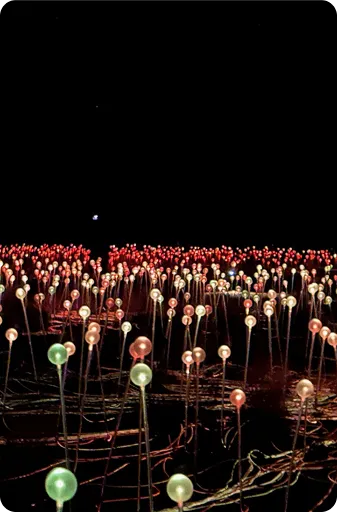
The moon hid shyly behind the clouds, but we didn’t need its glow. The music by the fire, the glittering canopy above, and the soft shimmer of the Field of Light in the distance made it a night touched by magic.
Drinking History
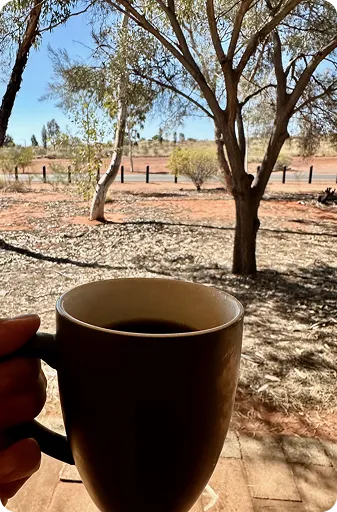
I was drinking my coffee one morning whilst staring at the red earth and white gum trees outside my room.
I was wondering where the water in Uluru came from. You see – I was reading that Fresh produce , fruits and vegetables are transported to Uluru once a week for the resorts from Alice Sorings about 450 km away . Do they transport water too ? ( as expected, the hotel bathroom has no bath tub ) And what I found out surprised me.
When you pour one in Uluru, you’re sipping history. The resorts don’t truck water in from cities; it comes from deep underground aquifers, where ancient rain has been resting for thousands of years. Pumped up, treated, and carefully rationed, it carries a mineral tang, tasting the desert’s geology through every drop.
So a glass of water is never “just water.” It’s so much more – a connection to the earth, to history and survival . It was astonishing . I made sure not to waste a drop of water in Uluru.