I’ve been to Cambodia three times: once to Siem Reap and twice to Phnom Penh.
It was, of course, Angkor Wat that first drew me to Cambodia. I’d also heard of travellers who came to “do good” — volunteering or supporting local non-profits. There’s even a term for it: “voluntourism.”
I visited Siem Reap with my mum in 2011. We stayed in a charming boutique hotel and had a private guide for the few days we were there. Let’s call him Steve.
Steve was in his early thirties and spoke good English, which he taught himself. He had been in the tourism industry for about twenty years, starting as a bellhop at a local hotel before deciding to become an entrepreneur. He bought a car, hired a driver, and began running private tours like the one we were on.
He was friendly and attentive. Before we left for Angkor Wat, he warned us about the many vendors who would surround tourists upon arrival. True enough, as our car pulled up, a crowd of young kids rushed forward, waving postcards, keychains, and stickers, calling out, “One dollar, one dollar!” None of them looked older than ten.
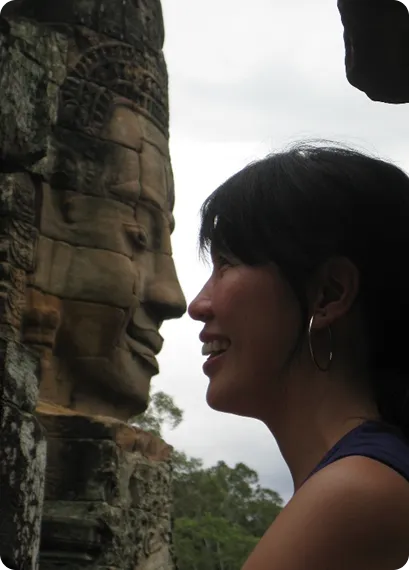
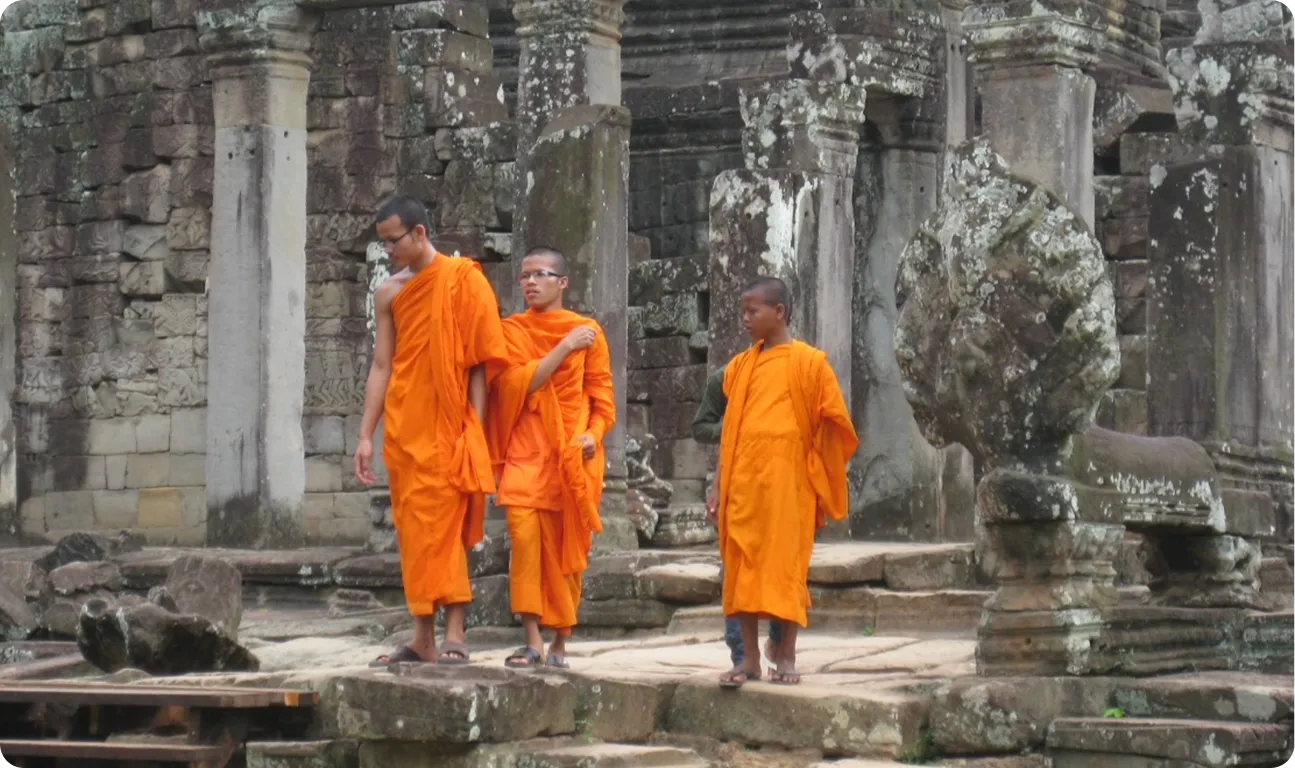
Angkor Wat was every bit as magnificent as I’d imagined, built around 1113–1150 by King Suryavarman II, and still the largest religious monument in the world. Covering over 400 acres, it was once a Hindu temple dedicated to Vishnu, later transformed into a Buddhist site. Its design follows perfect cosmic geometry – the central tower surrounded by four smaller ones represents Mount Meru, the mythical home of the gods.
The intricate reliefs tell stories from the Ramayana and Mahabharata, and the apsaras or celestial dancers, still seem to float across the stone walls. It’s mind-boggling to think this masterpiece was built more than 800 years ago.
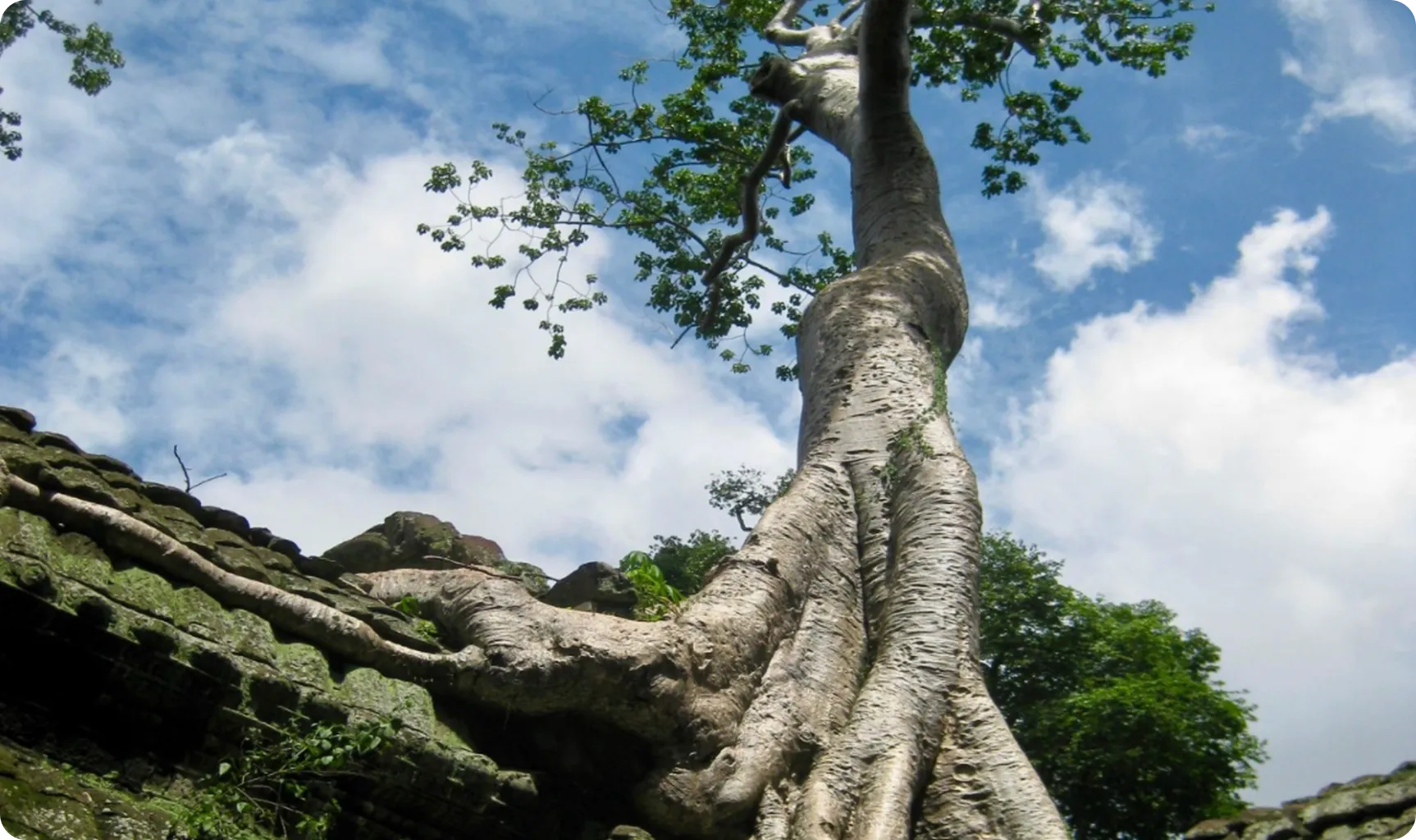
We also visited Ta Prohm, made famous by Angelina Jolie’s Tomb Raider. Nature and architecture intertwined, massive roots embracing the temple walls. Steve doubled as our photographer, suggesting perfect angles and even poses.
The next day, he took us to Tonlé Sap Lake for a boat ride, a must-do in Siem Reap. Tonlé Sap is Southeast Asia’s largest freshwater lake and one of the most fascinating natural wonders. As we cruised along, we saw houseboats lining the riverbanks: children playing, mothers cooking, men resting on hammocks in the afternoon heat.
Steve stood beside me and said quietly, “We are a poor country. You must be surprised how Cambodians live like this. Singapore is a rich country.”
I paused. A child’s laughter floated across the water.
“Actually,” I said, “many people in Singapore feel poor because the country is rich. Here at Tonlé Sap, everyone seems to be working hard and moving forward together. When everyone lives the same way, no one is poor.”
Steve smiled. Then he explained how the lake supports one of the most productive inland fisheries in the world, providing around 60% of Cambodia’s protein intake. He also told me about its remarkable rhythm: during the monsoon season, the Tonlé Sap River reverses its flow, expanding the lake’s size up to five times. It’s as if the whole landscape breathes with the seasons.
The next day, Steve invited us to visit his village. My mum and I agreed. Before heading there, we stopped at a local shop to buy small gifts, colouring kits and stationery for the children, and soap bars for the adults.
When we arrived, the villagers greeted Steve warmly. The children ran out to meet us. I wished I had brought along some of my children’s outgrown clothes — some of the little ones were unclothed.
The older women were fascinated by my mum. They touched her hand, stroked her face, and asked her age. When Steve translated her answer, “She’s 75.” There was a collective gasp. Mum was about 15 years older than most of them, but visibly more youthful. Their warmth and curiosity were touching.
Steve showed us the new wells recently built in the village. Each had a small plaque with the names of donors: “Built by Frank and Susan.” He explained that these were funded by tourists like us.
Feeling moved, I asked how we could help. Steve said two families were still hoping for wells. I offered to contribute towards them. He promised to have them built soon and to send us a photo once they were complete, with our names on the well. Mum was thrilled. She said the village reminded her of her own hometown in Malaysia in the 1950s.
Steve also shared that his dream was to open a small bed and breakfast and train other guides. His niece, he said proudly, was already learning English and working at a hotel. “Following your footsteps,” I teased. He beamed.
When our trip ended, Mum remarked how lucky we were to have Steve as our guide: warm, helpful, and sincere.
Back in Singapore, we told friends about the well we helped fund. Some were skeptical:
“Are you sure it’s real? Did you get proof?”
I brushed off their doubts at first, certain Steve would send the photo soon. Weeks turned into months. Then years. It’s been almost 15 years.
We never received the photo. But that’s all right. Our hearts were in the right place. I like to think that Steve did build that well, maybe with someone’s else name , maybe he lsot my email. I hope that he is living his dream, running his bed and breakfast with his team of guides.
Because sometimes, faith in goodness is its own reward.